


Accademia Gallery: entry ticket
4.3
- Entry to the David and the whole museum
- Temporary exhibitions included
- Option with the official audio guide in English
- Non-refundable
Pick a city
 10 min read
The Accademia Gallery is the Florence museum of Michelangelo's David, the marble statue that stands 517 cm tall with its base, at Via Ricasoli 58/60 in the San Marco area. It is open from Tuesday to Sunday, 8:15 to 18:50, the museum strongly recommends booking a time slot, and tickets in our box start from €29.00.
Here we at Where to go in Europe set out the opening hours until the end of February 2027, the free first Sundays, the choice between entry and guided tour, the bag size limit at the security check, the buses to San Marco and what to see room by room, from the Prisoners to the Stradivari instruments.



4.3
4.2
Availability checked on 28 November at 08:10. The price is the lowest of the next 3 months.
Got a question before or after booking? Write to us from the Contact page: we answer everyone.
Your booking arrives by email as soon as you pay and you show it from your smartphone. Nothing to print.
Tiqets and Viator have plenty of options: in the box you only find the ones we would book ourselves.
We check prices and dates for you: the time of the last check is written under the list.
Cancellation and date changes are under each option, with a tick if you can and a cross if you can't. No surprises later.
Our tickets box has two options: a timed entry ticket and a guided tour. Both get you into the whole museum, the David, the permanent collections and the temporary exhibitions. The entry ticket can’t be cancelled, while some options of the tour can be cancelled up to 24 hours before.
The entry ticket comes in three variants that you pick when you book: entry with a digital audio guide app, entry with the museum’s official audio guide, or hosted entry with assistance at the meeting point. If you just want to stand in front of the David at a set time, the basic one is enough.
The main option of the guided tour lasts about 1 hour, with a live guide and a headset to hear them, in English, Spanish, French, Italian or German: choose the language when you book. The other options on the same booking page include small-group tours in English.
The Accademia Gallery opens from Tuesday to Sunday, 8:15 to 18:50, with last admission at 18:10. It is closed every Monday and on 25 December and 1 January, which this winter both fall on a Friday.
| DAY | Open | Last admission |
|---|---|---|
| Tuesday to Sunday | 8:15-18:50 | 18:10 |
| Monday | Closed | - |
| 25 December and 1 January | Closed | - |
Closing starts 10 minutes early: from 18:40 you can no longer enter the musical instruments rooms on the ground floor or the rooms on the first floor. If you go in late in the afternoon, see those first and finish with the David.
Book a slot, above all for Tuesdays and weekends. The museum strongly recommends a reservation, because without one the wait to get in can be long. The ticket office keeps selling tickets for the day even when online availability is sold out, but the wait can be long.
When to go: the museum itself names Wednesday and Thursday between 13:00 and 14:30 as the quietest times, and December to February as the quietest months, public holidays excluded. From March to October it is peak season.
How long it takes: about 1h 30, by the museum’s own estimate.
On the first Sunday of every month admission is free for everyone, and on those days there is no booking: you wait your turn in front of the entrance door.
Visitors under 18 always get in free, collecting the ticket at the ticket office with an ID document, and children under 12 must be with an adult. Disabled visitors and one person accompanying them also get in free, with priority access.
The Accademia Gallery is at Via Ricasoli 58/60, in the San Marco area, in the block between Via Ricasoli, Via degli Alfani, Via de’ Servi and Via Cesare Battisti, next to the Academy of Fine Arts.
 Bus: San Marco Piazza, San Marco Basilica and Cavour San Marco stops, lines C1, 6, 14, 17, 18, 23, 31, 32 and 60 (not all of them in both directions)From Santa Maria Novella station: lines 6, 14, 18 and 23 link the station stops with the San Marco stops, in both directions
 By bike: cycle path on Via Cavour, bike stations in Piazza San Marco and on Via Ricasoli, in front of the Academy of Fine ArtsBy car: the museum has no visitor parking; the nearest paid car parks are San Lorenzo-Mercato Centrale, Piazza del Mercato Centrale 1, and Parterre, Via del Ponte Rosso 4
 Priority entrance: Via Ricasoli 60, the museum exit, for disabled visitors and their companion
Leave a few minutes for the security check. Everyone goes through a metal detector, and scissors, blades and other metal objects are held at the entrance and handed back at the end of the visit.
There is no café or restaurant inside the museum, and you can’t eat or drink in the rooms. A bottle of water of up to 0.5 litres is allowed, and any other food must stay sealed in your bag until you leave.
Plan your break before or after the David, not halfway through. These five are the best-rated places within a 15-minute walk, among those with at least 300 Google reviews.
Ratings and number of reviews from Google Maps, updated on 11 November 2026.
One variant of the entry ticket in our tickets box includes the museum’s official audio guide in English. The other two use a digital audio guide app: pack your own earphones and leave the hotel with a full battery.
The museum also hires out its own audio guides at the entrance: for adults in Italian, English, French, German, Spanish, Russian and Japanese, and in a children’s version in Italian, English, French, German and Spanish. You leave an original ID document as a deposit.
Prefer a person to a recording? The guided tour in the box has a live guide for about 1 hour in its main option, with the language chosen when you book.
A group can have at most 20 people, and from 6 people up whisper headsets are compulsory. Groups of more than 8 people book by phone through the museum’s booking service.
Ticket office staff can check the licence of whoever leads a group, to stop unlicensed guiding, and anyone without the right documents can be sent away.
Fewer of you and you want a guide anyway? Book one seat per person on the guided tour in the tickets box, with no group paperwork.
Under 18s get in free with ID, and children under 12 must be accompanied by an adult. There are baby changing facilities, and baby food and bottles are allowed as an exception to the food rule.
The whole visit route is accessible to wheelchair users, with a lift to the first floor and stairlifts in rooms 1 and 2 upstairs to reach the following rooms.
With a certified disability you and one companion get in free, with priority access and no reservation, using the entrance at Via Ricasoli 60, which is also the museum exit. Bring the documentation of the disability to show to the staff.
Wheelchairs are lent free of charge at the exit, without booking and subject to availability. Mobility scooters and electric wheelchairs can come in, but for the first-floor stairlifts you need a standard wheelchair.
The accessible toilet is on the ground floor near the lift: ask the bookshop staff for the key. For blind and partially sighted visitors there are tactile maps in the Hall of the Colossus and in room 1 upstairs, plus a tactile path on the ground floor, currently being revised.
Before the visit you can download two free materials from the museum’s website: an introduction kit and a social story that guides you through the museum rooms.
Animals are not allowed, except guide dogs, assistance dogs for disabled visitors and animals used in certified therapy. Show the documentation to the staff at the entrance.
There is no cloakroom, so the bag limit is strict: 40 x 30 x 18 cm. Suitcases, large backpacks and helmets don’t get in; the museum points to a luggage storage service at the MyAccademia store.
Trekking poles, selfie sticks and non-folding umbrellas stay at the entrance. Large umbrellas are left at the ticket gate in exchange for a number you show when you collect them; crutches and walking sticks for disabled visitors are allowed.
Photos for personal use are allowed, without flash or tripod, and you can sketch with pencils or a tablet. Keep your phone on silent, don’t sit on floors or steps and don’t lean on the bases of the statues.
Swimwear, bare chests and bare feet are not allowed. And keep in mind that the toilets are only reachable at the end of the visit route.
The entry ticket in our tickets box starts from €29.00, with three variants to choose from when you book: digital audio guide, official audio guide or hosted entry. The box also has a guided tour in five languages, and visitors under 18 are entitled to free admission at the museum ticket office, with ID.
The museum strongly recommends it: without a reservation the wait to get in can be long, especially on Tuesdays and at weekends. The ticket office still sells tickets on the day even when online availability is sold out, but for a set time book from the tickets box.
From Tuesday to Sunday, 8:15 to 18:50, with last admission at 18:10. From 18:40 the first floor and the musical instruments rooms close to visitors, so see them first if you go in late.
Every Monday, plus 25 December and 1 January. On the first Sunday of the month it is open and free for everyone, without booking.
About 1h 30, according to the museum. The guided tour in our box lasts about 1 hour in its main option, and the museum shows around 550 works on two floors, so allow more time if you want the paintings too.
Only if it is no bigger than 40 x 30 x 18 cm. The museum has no cloakroom, so suitcases, large backpacks and helmets are not allowed in. A water bottle of up to 0.5 litres is fine.
Yes, for personal use, without flash and without a tripod. Selfie sticks are not allowed in the rooms and must be left at the entrance.
The museum names Wednesday and Thursday, between 13:00 and 14:30, as the quietest times, and December to February as the quietest months, public holidays excluded. Tuesdays and weekends are the busiest days.
Start with Michelangelo, then follow the museum’s route through the other rooms, on the ground floor and the first floor.
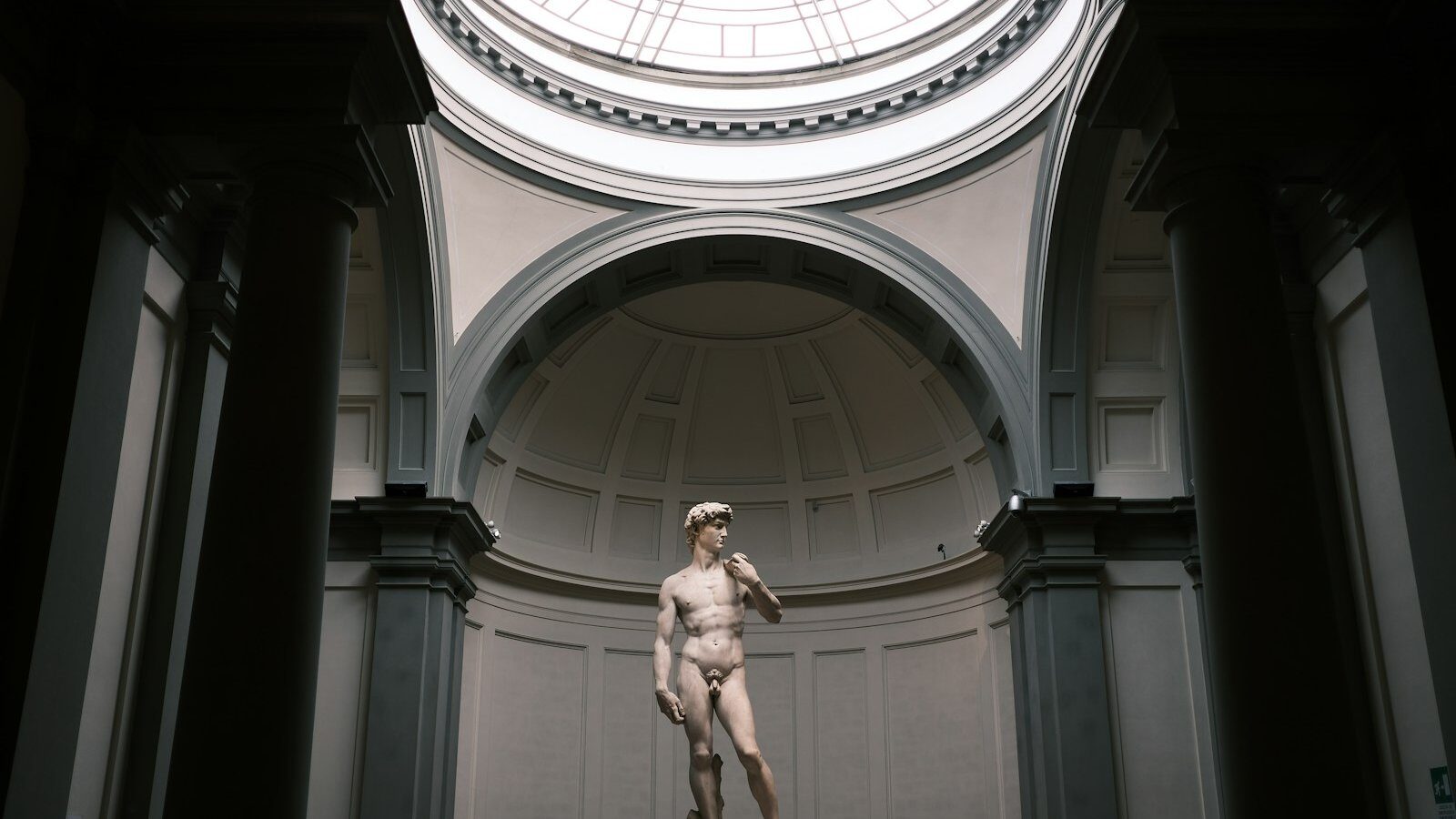
The David stands in the middle of the Tribuna, the space built for it at the end of the corridor. The white marble statue, carved between 1501 and 1504, is 517 cm tall with its base: walk around it and look at the trunk behind the right leg and at the sling, two of the parts that were originally gilded.
Carved between 1501 and 1504, the David is 517 cm tall with its base.

Four unfinished marble figures by Michelangelo line the corridor that leads to the David, carved between 1519 and 1534 for the tomb of Pope Julius II in Rome. Look at the surfaces for the marks of his tools, and at the Atlas, whose face barely emerges from the block. The same gallery holds his St Matthew and the Palestrina Pietà.
The first room of the visit has at its centre Giambologna’s full-size model in unfired clay for the Rape of the Sabine Women, the marble group in the Loggia dei Lanzi. On the walls hang 15th and 16th-century Florentine paintings by Paolo Uccello, Botticelli, Ghirlandaio and Filippino Lippi.
The monumental 19th-century hall is filled with plaster models by Lorenzo Bartolini and his pupil Luigi Pampaloni, together with paintings by former students of the Academy of Fine Arts. On the left wall as you enter, a fresco by Pontormo shows the room when it was the women’s ward of the Hospital of San Matteo.
Three ground-floor rooms hold panels painted on gold backgrounds between the 13th and the early 15th century, by Giotto, Bernardo Daddi, Taddeo and Agnolo Gaddi, Orcagna and Giovanni da Milano. Look for The Tree of Life by Pacino di Bonaguida, one of the works on the tactile path.
Around fifty instruments from the collections of the Medici and Lorraine grand dukes, which come from the Luigi Cherubini Conservatory next door. Look for the tenor viola and the cello by Antonio Stradivari, made for Grand Prince Ferdinando de’ Medici, and for a spinet and a pianoforte by Bartolomeo Cristofori, the inventor of the piano.
Upstairs, reached by lift, three rooms are dedicated to Lorenzo Monaco and Late Gothic painting in Florence, full of gold and bright colours. Among his works, look for the Agony in the Garden, with three apostles asleep. Remember that this floor closes to visitors at 18:40.


