


Royal Palace of Madrid: fast-track entry
4.5
- Fast-track entry to the Royal Palace of Madrid
- Downloadable booklet on the royal palaces in and around Madrid
- No guided tour
- Royal Kitchen not included
- Non-refundable
Pick a city
 11 min read
The Royal Palace of Madrid is the official residence of the King of Spain, on Calle de Bailén in the centre of the city, and one of the few official residences of a head of state open to the public. The royal family doesn't live there: the King uses it for state ceremonies, and fast-track entry starts from €22.00.
In this guide we at Where to go in Europe cover the opening hours until February 2027, the days it closes for official events, the free hours, how to get there by metro, the rules at the security check and the rooms to look for inside, from the Throne Room to the Royal Armoury.



4.5
4.4
Availability checked on 28 November at 08:10. The price is the lowest of the next 3 months.
4.2
Got a question before or after booking? Write to us from the Contact page: we answer everyone.
Your booking arrives by email as soon as you pay and you show it from your smartphone. Nothing to print.
Tiqets and Viator have plenty of options: in the box you only find the ones we would book ourselves.
We check prices and dates for you: the time of the last check is written under the list.
Cancellation and date changes are under each option, with a tick if you can and a cross if you can't. No surprises later.
From October to March the Royal Palace opens at 10:00 every day and closes at 18:00 from Monday to Saturday, at 16:00 on Sunday. From April summer hours start, with weekdays and Saturdays until 19:00, while Sunday always closes at 16:00.
| PERIOD | Monday to Saturday | Sunday | Last entry |
|---|---|---|---|
| October to March | 10:00-18:00 | 10:00-16:00 | 17:00, Sunday 15:00 |
| April to September | 10:00-19:00 | 10:00-16:00 | 18:00, Sunday 15:00 |
The palace is still the seat of the Head of State, so official events come first and some days change:
| DAY | What happens |
|---|---|
| 17 and 18 November 2026 | Closed for official events |
| Other official events | Closures and reduced hours are published by Patrimonio Nacional, the body that runs the palace |
| Monday to Thursday, 16:00-18:00 | Free hours for EU and Ibero-American citizens, see below |
The ticket office and the entrance close one hour before the palace, so the last entry is at 17:00 in winter and at 15:00 on Sunday. Visits can also be suspended when the royal family needs the building.
Your ticket is valid for one visit, on the date and time slot you booked. Keep it until the end of the visit. At busy moments the security staff can restrict access to manage the crowd.
Book ahead rather than at the door. Capacity is limited to protect the rooms, and Patrimonio Nacional itself says the ticket office on site sells only a reduced number of tickets.
From Monday to Thursday, 16:00 to 18:00 between October and March, entry is free for citizens of the European Union, people who live or hold a work permit there, and citizens of Ibero-American countries. You show proof of nationality or residence at the ticket office, and the last entry is at 17:00.
During these hours the Royal Kitchen stays closed, and groups can’t book or have a guided visit. From April to September the free slot moves to 17:00-19:00.
The nearest metro stop is Ópera, on lines 2 and 5 and on the Ramal to Príncipe Pío. Visitors and groups go in from the Almudena esplanade, at the corner with Calle de Bailén.
 Metro L2, L5 and Ramal: Ópera stop, an accessible stationMetro L6, L10 and Ramal: Príncipe Pío stop, an accessible station
 Bike: the nearest BiciMAD station is number 36Entrance: Almudena esplanade, corner of Calle de Bailén, for individual visitors and groups
Leave some margin before your slot. Every visitor goes through a security check, all bags pass through a scanner, and scooters, skateboards and bicycles, folding ones included, are not allowed in.
Eat before or after the visit. Food and drinks are not allowed in the rooms, with exceptions for children, older visitors, pregnant visitors and people with diabetes or other conditions, which the security staff assess.
Don’t plan a picnic in the palace gardens either: in Patrimonio Nacional’s gardens eating and picnics are only allowed in the areas marked for it, and alcohol is not allowed.
These three are the best-rated places within a 15-minute walk, among those with at least 300 Google reviews.
Ratings and number of reviews from Google Maps, updated on 11 November 2026.
The fast-track ticket in the tickets box has no audio guide and no guide: it comes with a downloadable booklet on the royal palaces in and around Madrid. Patrimonio Nacional sells its own audio guide and guide service as extras, through its ticket channels and at the desks in the palace.
If you want someone to explain the rooms, the second option in the box is a 2-hour guided tour with entry to the palace, led by a guide certified by the tourism authority. It runs in English or Spanish, you choose the language when you book, and a headset lets you hear the guide. You can cancel it for free until 23:59 on the day before your visit.
Organised groups have at least 9 members and, at the Royal Palace, at most 30, always led by an official tourist guide, an agency, a teacher or a Patrimonio Nacional guide. They book online in the time slots set aside for groups.
Groups of 9 or more must use the headset guiding system where it is available, unless an agency or official guide brings its own. They have to arrive 15 minutes before their slot and leave rucksacks in the cloakroom when there is room.
Fewer than 9 of you? Each of you books an individual ticket, or a place on the guided tour in the tickets box.
Children under 14 can’t go in alone and must stay with an adult for the whole visit. Inside, nobody can run, sit on the floor of the passageways or touch the works of art, and children can’t be left without an adult.
The palace has access for people with reduced mobility and lends manual wheelchairs. If you borrow one, you fill in a form and return it at the end of the visit. Patrimonio Nacional also publishes an easy-to-read guide to the palace, room by room.
Patrimonio Nacional’s accessibility leaflet, which dates from 2016, describes ramps to the Royal Armoury, the state rooms on the main floor and the temporary exhibition rooms, adapted toilets next to the temporary exhibitions and, at the visitor reception centre, an information point for visitors with sensory disabilities, with a tactile floor plan and texts in braille.
Visitors with a disability certificate of 33% or more go in free, together with a companion when the certificate says one is needed: show the certificate and ID at the ticket office. Ópera metro station is accessible.
Only guide dogs and accredited assistance dogs are allowed in. Any other animal stays out, and the same goes for the Campo del Moro gardens, where dogs are not allowed except assistance dogs.
At the entrance every bag goes through the scanner. Weapons, dangerous items, objects too big for the scanner, animals, scooters, skateboards, bicycles and works of art are not allowed in, and people who are drunk are turned away.
The cloakroom is free and has limited space. Large rucksacks, suitcases, bags of 40 x 40 cm or more, umbrellas that don’t fold, walking sticks with a metal tip and sharp objects must be left there.
Photos are allowed without flash, for personal use, except where signs say otherwise. Tripods, selfie sticks and stabilisers are not allowed, and you can’t photograph other visitors or the staff without their consent.
Inside you can’t touch the works, run, eat, use laser pointers or lie on the sofas and benches. Bare feet, costumes and inappropriate clothing are not allowed, keep your voice down and your phone on silent, and sketching is fine in pencil on a notebook no bigger than A4.
The fast-track entry in our tickets box starts from €22.00. The box also has a 2-hour guided tour in English or Spanish, and the Madrid Pass, where the Royal Palace is one of the choices, alongside options such as the Bernabéu stadium museum and a hop-on hop-off bus.
From October to March it opens at 10:00 every day and closes at 18:00 from Monday to Saturday, at 16:00 on Sunday. The ticket office and the entrance close one hour earlier, so the last entry is at 17:00, or 15:00 on Sunday.
Yes, when it hosts official events. It is closed on 17 and 18 November 2026, and further closures are announced on the Patrimonio Nacional website. Visits can also be suspended when the royal family needs the palace.
From Monday to Thursday, 16:00 to 18:00 between October and March, entry is free for EU citizens, EU residents or work permit holders and citizens of Ibero-American countries, with proof at the ticket office. Last entry is at 17:00, and the Royal Kitchen can't be visited in those hours.
Not in the fast-track ticket in our box. The Royal Kitchen is a separate visit, only with a guide and in groups of up to 25, and it is not open during the free hours.
Yes, without flash and for personal use, except where signs say otherwise. Tripods, selfie sticks and any other stabiliser are not allowed, and you can't photograph other visitors or the staff without their consent.
Large rucksacks, suitcases and bags of 40 x 40 cm or more go into the cloakroom, which is free, together with non-folding umbrellas and walking sticks with a metal tip. Every bag goes through the security scanner, and anything too big for it can't come in.
No: children under 14 must be with an adult for the whole visit. Children under 5 go in free.
These are the spaces you walk through on the visit, in the order of the route, plus the Armoury and the Kitchen.
This is the large square you cross to reach the main entrance of the palace. The Royal Armoury stands at the end of the wing that closes the square on the side of the Campo del Moro park.
The palace is the official residence of the King of Spain, used for state ceremonies.

The route starts up the main staircase, with low steps designed for an easy climb. Look at the two lions on the handrail, one turned to look down, and stop at their level: from there you see the whole ceiling fresco by Corrado Giaquinto.
The first room was the guard room of the halberdiers, Charles III’s guards. The walls are kept simple, with plain pilasters, so look up at the ceiling fresco by Giambattista Tiepolo, and find the portrait of King Juan Carlos I’s family by Antonio López, who took 20 years to paint it.
Once the gala dining room, this hall was later used to receive heads of state, for concerts and for signing important documents. The walls carry 17th-century Brussels tapestries on the Acts of the Apostles, and the ceiling is again by Giaquinto.
Charles III’s rococo chamber, decorated by Mattia Gasparini, took 55 years to finish. Look at the coloured marble floor with plant motifs, the same pattern embroidered in silver and gold on the walls and chairs, and the Shepherd clock, an automaton more than 260 years old that still works.
This small room is covered in porcelain plaques from floor to ceiling, screwed onto wood fixed to the walls and made by the Buen Retiro royal factory. The figures show festivities for Bacchus, and there is a clock that represents Atlas.
The table seats up to 144 guests and is 40 metres long, made of boards that can be taken apart. Look up and you will see three ceiling sections, one for each of the three rooms joined to create the hall, and on the walls the oldest tapestries in the palace, woven in Brussels in the 16th century.
This is the tallest space in the palace, under a dome painted by Giaquinto with the coronation of the Virgin. Look for the ten columns, each carved from a single piece of black veined marble, and the 18th-century organ, which still works and is used for concerts.
Here you see a string quartet made by Antonio Stradivari: two violins, a viola and a cello, decorated with ivory circles and diamonds along the edges. There is also a fifth instrument, an undecorated cello for a soloist, and the quartet is still played at concerts in the Hall of Columns.
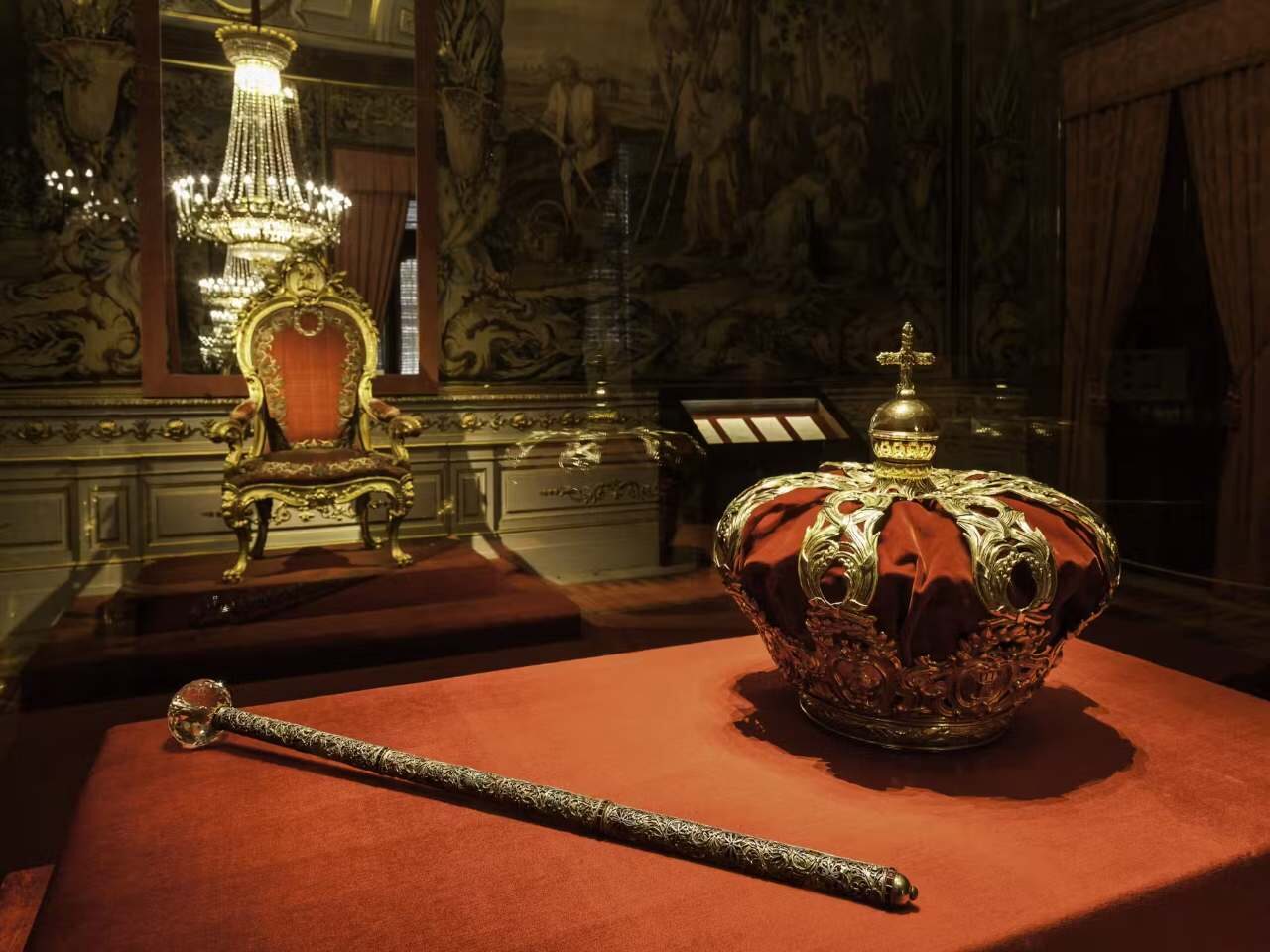
This room keeps the crown, the sceptre and Charles III’s throne, the chair with lion’s paw feet and the king’s face carved on the back. The crown is not meant to be worn, and in the same room you see a Golden Fleece collar with 65 links of silver and gold.
It is still where the King holds the most important ceremonies, such as the Pascua Militar and the receptions where guests greet the royals. The decoration is the original one: Tiepolo’s ceiling, twelve consoles with mirrors, and four statues of the virtues of good government around the throne.
Patrimonio Nacional considers it, together with the Imperial Armoury in Vienna, the most important armoury in Europe. It is mostly ceremonial armour and weapons, from the arms of Charles V to swords forged in Toledo.
It is a separate visit, only with a guide, and the fast-track ticket in the box doesn’t include it. It fills the side of the first basement: look for the stoves, the ovens, the dumbwaiter that carried dishes up to the main floor and one of the first refrigerators.
Not sure which time slot or option fits your day in Madrid? Write to us from the Contact page: we answer everyone.


