


Blue Mosque: guided tour in English
4.0
- Guided tour in English, 1h
- Licensed local guide
- Ends inside the mosque, then free time to look around
- Free cancellation up to 24 hours before
Pick a city
 6 min read
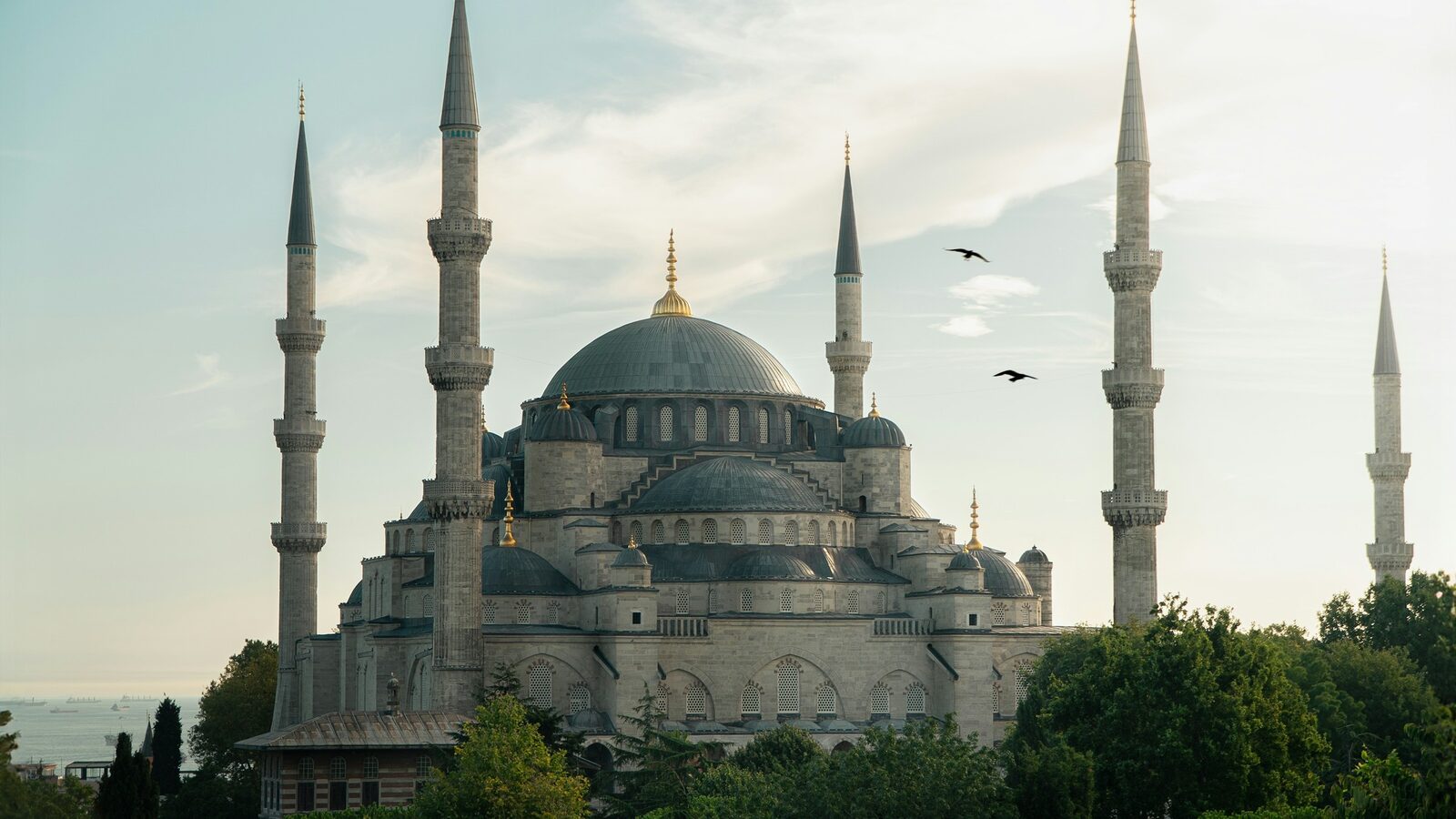
The Blue Mosque, Sultanahmet Camii in Turkish, is the mosque Sultan Ahmed I had built between 1609 and 1617 on Sultanahmet Square, in the old city of Istanbul, and it is still a working place of worship. Visiting it is free, and if you'd rather go in with someone who explains what you're looking at, the guided tours in our box start from €16.49.
In this guide we at Where to go in Europe cover the visiting hours until March 2027 and the prayer-time closures, why Friday mornings don't work, what to wear in the mosque and its courtyard, how to get there on the T1 tram and what to look for, from the İznik tiles to the six minarets.



4.0
4.8
Availability checked on 28 November at 08:10. The price is the lowest of the next 3 months.
Got a question before or after booking? Write to us from the Contact page: we answer everyone.
Your booking arrives by email as soon as you pay and you show it from your smartphone. Nothing to print.
Tiqets and Viator have plenty of options: in the box you only find the ones we would book ourselves.
We check prices and dates for you: the time of the last check is written under the list.
Cancellation and date changes are under each option, with a tick if you can and a cross if you can't. No surprises later.
The Blue Mosque is open to visitors seven days a week, from 8:30 to 17:00 between October and March and from 8:30 to 19:00 between April and September. The last visitors go in 30 minutes before closing.
| PERIOD | Visits | Last entry |
|---|---|---|
| 1 October to 31 March | 8:30-17:00 | 16:30 |
| 1 April to 30 September | 8:30-19:00 | 18:30 |
Within those hours, visits stop for two prayers a day, and on Friday they only start in the afternoon:
| WHEN | What happens |
|---|---|
| Friday | Visits from 14:30: the morning is kept for cleaning and for preparing the Friday prayer, open to worshippers only |
| Noon prayer, every day | Closed to visitors from 30 minutes before the call to prayer until 15 minutes after the prayer ends |
| Afternoon prayer, every day | Closed to visitors with the same rule: 30 minutes before the call, 15 minutes after the prayer |
| Every day, for worship | Open from the dawn call to prayer until the end of the night prayer |
Prayer times move every day with the sun, so the closures never fall at a fixed hour. Türkiye’s Presidency of Religious Affairs publishes the daily times for Istanbul on its prayer times page: look at the noon and afternoon prayers before you set off.
On Friday, don’t plan the Blue Mosque for the morning. Until 14:30 the doors are open only to worshippers, so put another sight first and come here in the afternoon.
Visiting is free. What you pay for in our tickets box is a guide: a one-hour tour of the Blue Mosque in English, or a four-hour walk that adds the Süleymaniye Mosque and Hagia Sophia, where Hagia Sophia’s entry is paid separately.
Ride the T1 tram (Kabataş-Bağcılar) to Sultanahmet, the closest stop. The mosque is at At Meydanı 7, with its main gate facing the old Hippodrome, today Sultanahmet Square.
 Tram T1 (Kabataş-Bağcılar): Sultanahmet stopMetro and Marmaray: change to the T1 tram, which connects with both
 From the Asian side: ferry from Kadıköy or Üsküdar to Eminönü, then the T1 tram to SultanahmetGuided tour meeting points: the one-hour tour meets at At Meydanı Caddesi 10, the four-hour walk at the German Fountain on the square
Leave the car at the hotel. The mosque has no car park, and the private car parks in the area have only a few spaces.
These five are the best-rated places within a 15-minute walk, among those with at least 300 Google reviews.
Ratings and number of reviews from Google Maps, updated on 12 November 2026.
The Blue Mosque is a working place of worship, and the dress rules apply in the courtyard as well. Visitors must cover the parts of the body that prayer rules require to be covered, inside the mosque and in its courtyard.
If what you’re wearing isn’t suitable, you don’t need to go back and change: the mosque has a booth that lends clothing, and you hand the garments back to the same booth on your way out.
The floor of the prayer hall is carpeted, because prayer includes prostration with the forehead on the ground, and for the same reason Muslims take off their shoes before going in, so the place where they pray stays clean.
Inside, the visitors’ area and the prayer area are kept apart: stay on your side. Keep your voice down inside and around the mosque, don’t smoke in the courtyard, and follow the instructions of the security staff and of the attendants wearing a staff ID card.
Strollers are not allowed inside the mosque. With a baby or a toddler, a carrier saves you from leaving the stroller outside with someone from your group.
Yes, visits to the mosque are free. What you can pay for is a guide: the tours in our tickets box start from €16.49, with a one-hour tour of the Blue Mosque in English or a four-hour walk that adds the Süleymaniye Mosque and Hagia Sophia (Hagia Sophia entry not included).
From 1 October to 31 March visitors can go in from 8:30 to 17:00, from 1 April to 30 September from 8:30 to 19:00. The last entry is 30 minutes before closing, and the mosque is open seven days a week.
Yes, for visitors it closes around the noon and afternoon prayers, from 30 minutes before the call to prayer until 15 minutes after the prayer ends. The times change every day: check them on the Diyanet prayer times page.
Only in the afternoon. On Friday visits start at 14:30: until then the mosque is kept for cleaning and for preparing the Friday prayer, and it stays open only to worshippers.
You must cover what prayer rules require to be covered, both inside the mosque and in the courtyard. If your clothes aren't suitable, the mosque lends garments from a clothing booth, and you return them to the same booth.
No, strollers are not allowed inside the mosque. With a baby, a carrier is the easier option.
The Blue Mosque tour in our tickets box lasts about 1 hour and ends inside the mosque, where you can stay on your own. The walking tour of the three mosques lasts 4 hours, with a local drink in a historic madrasa.
Here is what to look for, from the square outside to the prayer hall.
It is the only mosque in Türkiye with six minarets, in an arrangement that had never been tried before: four stand at the corners of the prayer hall and two at the corners of the courtyard. They are built of küfeki stone.
The main gate looks onto the Hippodrome, where the obelisks stand. Above it there are two Arabic inscriptions: the declaration of faith at the top and, just over the arch, a Qur’an verse saying that prayer is prescribed at set times.
More than 21,000 tiles cover the walls of the prayer hall, made in İznik and Kütahya with plant and flower patterns in over fifty compositions. White and green are there too, but blue is what you see first as you walk in, and it is why Westerners called it the Blue Mosque.
The central dome is 43 metres high and rests on four round pillars 5 metres across, known in Turkish as “fil paye”, elephant feet. At the top of each pillar there is a Qur’an verse in gold letters on a blue ground, and another verse is written on the keystone at the centre of the dome.
260 windows let the light into the hall, which is why it feels so bright and airy. The calligraphy on the walls, Qur’an verses and the attributes of God, is by Seyyid Kasım Gubari, the famous calligrapher of the time.
The mihrab is the marble niche that points towards Mecca, shaped to carry the imam’s voice back to the rows behind him. Beside it, the carved marble minbar is used for the Friday sermon and the two Eid prayers, while the royal lodge had its own entrance so the sultan could pray with the congregation.
Something unclear before your visit? Write to us from the Contact page: we answer everyone.


