


Prado Museum: entry ticket
4.7
- Entry to the Prado Museum
- Dedicated entrance to the collection via the Jerónimos entrance
- Non-refundable
Pick a city
 11 min read
The Prado Museum, officially Museo Nacional del Prado, stands on the Paseo del Prado in Madrid and shows around 1,800 works in more than 100 rooms, from Velázquez's Las Meninas to Goya and Bosch. You enter with a ticket for a set date and time, and the entry ticket starts from €18.00, with the temporary exhibitions included in the visit.
In this guide we at Where to go in Europe cover the opening hours until February 2027, the free last two hours of the day, which door to use and how to get there by metro, the bag and photo rules, where to eat and in which rooms to find the paintings people come for.



4.7
4.4
Availability checked on 28 November at 08:10. The price is the lowest of the next 3 months.
4.4
Got a question before or after booking? Write to us from the Contact page: we answer everyone.
Your booking arrives by email as soon as you pay and you show it from your smartphone. Nothing to print.
Tiqets and Viator have plenty of options: in the box you only find the ones we would book ourselves.
We check prices and dates for you: the time of the last check is written under the list.
Cancellation and date changes are under each option, with a tick if you can and a cross if you can't. No surprises later.
The Prado opens at 10:00 every day and closes at 20:00 from Monday to Saturday, at 19:00 on Sundays and public holidays. There is no weekly closing day: the museum shuts only on 25 December, 1 January and 1 May.
| PERIOD | Monday to Saturday | Sunday and public holidays |
|---|---|---|
| All year | 10:00-20:00 | 10:00-19:00 |
Around Christmas three dates have short hours and two are closed:
| DAY | What happens |
|---|---|
| 24 December | Open 10:00-14:00 |
| 25 December | Closed |
| 31 December | Open 10:00-14:00 |
| 1 January | Closed |
| 6 January | Open 10:00-14:00 |
You can get in until 30 minutes before closing, and the staff start clearing the rooms 10 minutes before. Ticket sales also stop half an hour before closing, so a late arrival leaves you very little time.
The ticket has a date and a time pass: choose them when you book and stick to them, because the museum has a maximum capacity and checks it at the doors. The ticket is personal and valid once, and you can’t leave and come back in with it.
The ticket offices of the Goya entrance open 15 minutes before the museum, the others at 10:00. Occasionally a room can be closed for maintenance, and the museum doesn’t refund or discount the ticket for that.
Entry to the collection is free in the last two hours before closing. The free tickets are handed out at the ticket offices until the museum is full, and the temporary exhibitions are not included, only discounted.
If the Prado is the reason you came to Madrid, don’t rely on the free slot. Two hours, after a queue, are enough for a handful of rooms, and you can’t book ahead.
Some visitors never pay: under 18s, students aged 18 to 25, people with a disability of 33% or more and unemployed people, among others. They show official, valid ID at ticket offices 1 or 2 on the day, which have priority access; under 12s don’t need to show anything.
The bus stops right outside, and the nearest metro stations are Banco de España (line 2, 650 m) and Estación del Arte (line 1, 800 m). The ticket offices are at the Goya entrance, on Calle Felipe IV.
 Metro L2: Banco de España (650 m) or Retiro (1.3 km). Metro L1: Estación del Arte (800 m)
 Bus: 001, 10, 14, 27, 34, 37, 45 and C03, stop Museo del Prado - Jardín Botánico, 64 m away
 Cercanías trains: Atocha (1 km, lines C1, C2, C3, C3A, C4, C5, C7, C8 and C10) or Recoletos (1.1 km)Entrances: Goya entrance on Calle Felipe IV for the ticket offices and the collection; Jerónimos entrance on the same street for the temporary exhibitions, the collection and priority access
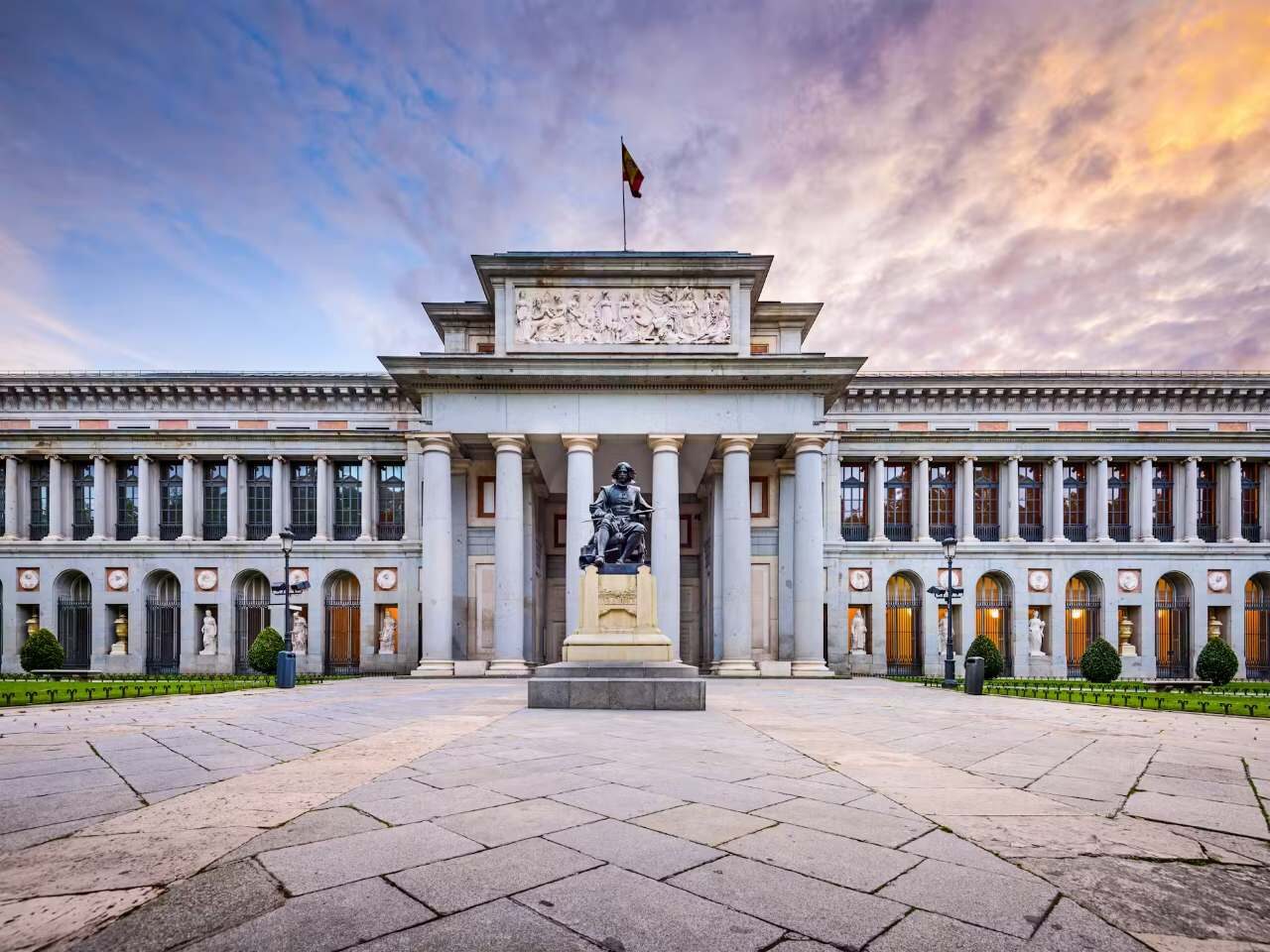
 Guided tour meeting point: the Velázquez monument on the Paseo del Prado
From the airport you can take metro line 8 and change to lines 4 and 2, the Cercanías C1 or C10 trains to Recoletos or Atocha, or bus 203.
The museum has no car park. The nearest public ones are on Calle Montalbán, Plaza de las Cortes and Plaza Sánchez Bustillo. By bike, the closest BiciMAD stations are at Calle Espalter 1, Calle Jesús 1 and Calle Almadén 28.
Inside there is the Café Prado, in the Jerónimos hall, with a restaurant service, but you need a museum ticket to reach it. It closes 30 minutes before the museum, and it is the only place inside where you can eat or drink.
Sealed food and drinks can’t go into the rooms: they go to the cloakroom, packed inside a bag or backpack. Unsealed food is not allowed in at all, so have a proper meal before or after.
Outside, these five are the best-rated places within a 15-minute walk, among those with at least 300 Google reviews.
Ratings and number of reviews from Google Maps, updated on 11 November 2026.
The museum’s audio guide explains more than 250 works in 15 languages, with routes through the masterpieces of 1, 2 and 3 hours. It is sold together with the museum’s own tickets and works on the museum’s devices or on your smartphone.
You pick up the device at the audio guide desks in the Jerónimos hall, the upper Goya rotunda or the Sala de las Musas. Wifi is available only in the Jerónimos hall and in the temporary exhibition rooms, so download what you need before you go in.
If you’d rather follow a person, the second option in the tickets box is a 2-hour guided tour in English or Spanish, entry included: you choose the language when you book. It starts from the Velázquez monument on the Paseo del Prado.
From 9 people up you are a group, up to 20 including the guide (school groups up to 30). Groups must book and buy online at least 24 hours ahead, and the visit is limited to 1 hour 30 minutes.
Every group in opening hours must use the museum’s guiding system, with microphone and wireless earphones, except nursery and primary school groups. In the temporary exhibitions in the Jerónimos building, a group can have at most 15 people.
Groups can also visit before opening, from 9:00 to 10:00, with at least 12 people and their own guide, booking at least 72 hours ahead. Fewer than 9 of you? You are individual visitors, and each of you can book a place on the guided tour in the tickets box.
Children under 14 can’t visit alone: an adult must be with them for the whole visit. Under 18s get in free, and under 12s don’t need to show ID at the ticket office.
The Prado has no architectural barriers: lifts, ramps, platforms and accessible toilets cover the route, and the café, the shop and the auditorium are accessible too. Wheelchairs are lent for free at the cloakroom, but there are few, so the museum recommends bringing your own.
Disabled visitors get in free, with priority access to ticket offices 1 and 2 and to the building through the Jerónimos entrance. They can reserve ticket and time slot by email with the museum’s accessibility service and collect them on the day.
There are municipal parking spaces for vehicles with a disability badge on Calle Ruiz de Alarcón and Calle Moreto. The museum lets cars drop off and pick up visitors with reduced mobility next to the entrance, on request by email.
The audio guide desks lend free signoguides in Spanish Sign Language with subtitles for 52 masterpieces, audio description for 53 masterpieces and induction loops; the counters and the auditorium have an induction loop too. An accessible map with a route of 10 masterpieces, all on floor 1, is available at the information desks.
Assistance dogs with their accreditation are the only animals the Prado lets in. If you travel with a pet, someone will have to stay with it while you are inside.
No photos or filming in the rooms, in the collection or in the temporary exhibitions. The exceptions are the Jerónimos hall, the Sala de las Musas and the Cloister.
At the door everyone goes through the security scanner. Backpacks, bags and parcels of 40 cm or more, motorbike or bike helmets, non-folding umbrellas and pointed walking sticks go to the free cloakroom.
You can’t bring in scooters, skateboards, bikes or skates, flowers and plants, unsealed food or musical instruments. Anything that doesn’t fit through the scanner can’t come in or go to the cloakroom either, which rules out large suitcases.
Inside, don’t touch the works, run, walk barefoot or use laser pointers. Keep your voice down, avoid phone calls, and don’t lie on the sofas or sit on the floor in the passageways. Drawing is allowed on paper up to A4, with dry techniques only.
The entry ticket in our tickets box starts from €18.00 and covers the collection and the temporary exhibitions. Visitors under 18 get in free, like students aged 18 to 25: they show their ID at ticket offices 1 or 2 on the day, except under 12s.
In the last two hours before closing. Free entry covers the collection only, the tickets are handed out at the ticket offices and they run out when the museum is full, so expect a queue.
Monday to Saturday 10:00-20:00, Sundays and public holidays 10:00-19:00. On 24 and 31 December and 6 January it closes at 14:00, and it is closed on 25 December, 1 January and 1 May. The last entry is 30 minutes before closing.
The ticket offices are at the Goya entrance, on Calle Felipe IV. The Jerónimos entrance, on the same street, leads to the temporary exhibitions and the collection, and the entry ticket in our box uses a dedicated entrance there.
No, not in the collection rooms or in the temporary exhibitions. Photos are allowed only in the Jerónimos hall, the Sala de las Musas and the Cloister. You can draw in the rooms on paper up to A4, with pencils or other dry techniques.
Bags and backpacks of 40 cm or more go to the cloakroom, which is free. Anything too big for the security scanner can't come in at all, so leave large suitcases at the hotel. The cloakroom has limited space.
In Room 12, on floor 1, in the Velázquez rooms. Goya's The Family of Charles IV is in Room 32 on the same floor, and The Third of May 1808 is in Room 64 on floor 0.
Plan at least two hours. The museum suggests itineraries of 1, 2 and 3 hours through the masterpieces, and the guided tour in our box lasts 2 hours. Once you leave you can't go back in with the same ticket.
The museum map marks these works and their rooms: Las Meninas, Goya’s The Family of Charles IV and Rubens’s The Three Graces are on floor 1, the Flemish masters and The Third of May on floor 0.
The Infanta Margarita stands at the centre, between her two maids, with Velázquez himself on the left in front of a huge canvas. Look at the mirror next to the back door: it reflects King Philip IV and Queen Mariana, standing where you are standing.
In The Family of Charles IV Goya paints thirteen members of the royal family and himself, at an easel on the darker left side. Queen María Luisa is at the centre. A few rooms away, in Room 38, hangs The Naked Maja.
A firing squad in grey coats, faces hidden, aims at a group of men lit by a lantern on the ground. At the centre, the man in the white shirt raises his arms; in the background you can make out two Madrid church towers.
Bosch’s triptych hangs in Room 56A, among the Flemish rooms of floor 0. Next door, in Room 55A, are Pieter Bruegel the Elder’s The Triumph of Death, with an army of skeletons led by Death on a reddish horse, and Patinir’s Crossing the River Styx.
The figures are almost life-size, which was rare in Flemish painting of the time. The fainting Virgin repeats the pose of Christ’s body, and on the right Mary Magdalene bends over with her hands clasped. In the same room is Antonello da Messina’s Dead Christ Supported by an Angel.
Dürer’s Self-Portrait is in Room 55B, Fra Angelico’s The Annunciation and Mantegna’s The Death of the Virgin in Room 56B. They sit right by the Bosch and Bruegel rooms, so you can see them in the same loop.
Rubens’s The Three Graces, in Room 29, shows three goddesses in a circle, one seen from behind, with Cupid on a fountain beside them. El Greco’s The Nobleman with his Hand on his Chest is in Room 8B, and Titian’s The Bacchanal of the Andrians in Room 42.
Floor 2 holds the Dauphin’s Treasure, the highlight of the museum’s decorative arts: the map picks out a gold cup with a mermaid. On the same floor are Rembrandt’s Judith at the Banquet of Holofernes in Room 76 and Goya’s The Threshing Floor in Room 85.


