


Sagrada Familia: fast-track entry, towers optional
4.7
- Skip the line
- Audio guide in English, on your phone
- Tower access, if you choose that option
- Free cancellation on some options
- Date change possible on some options
Pick a city
 11 min read
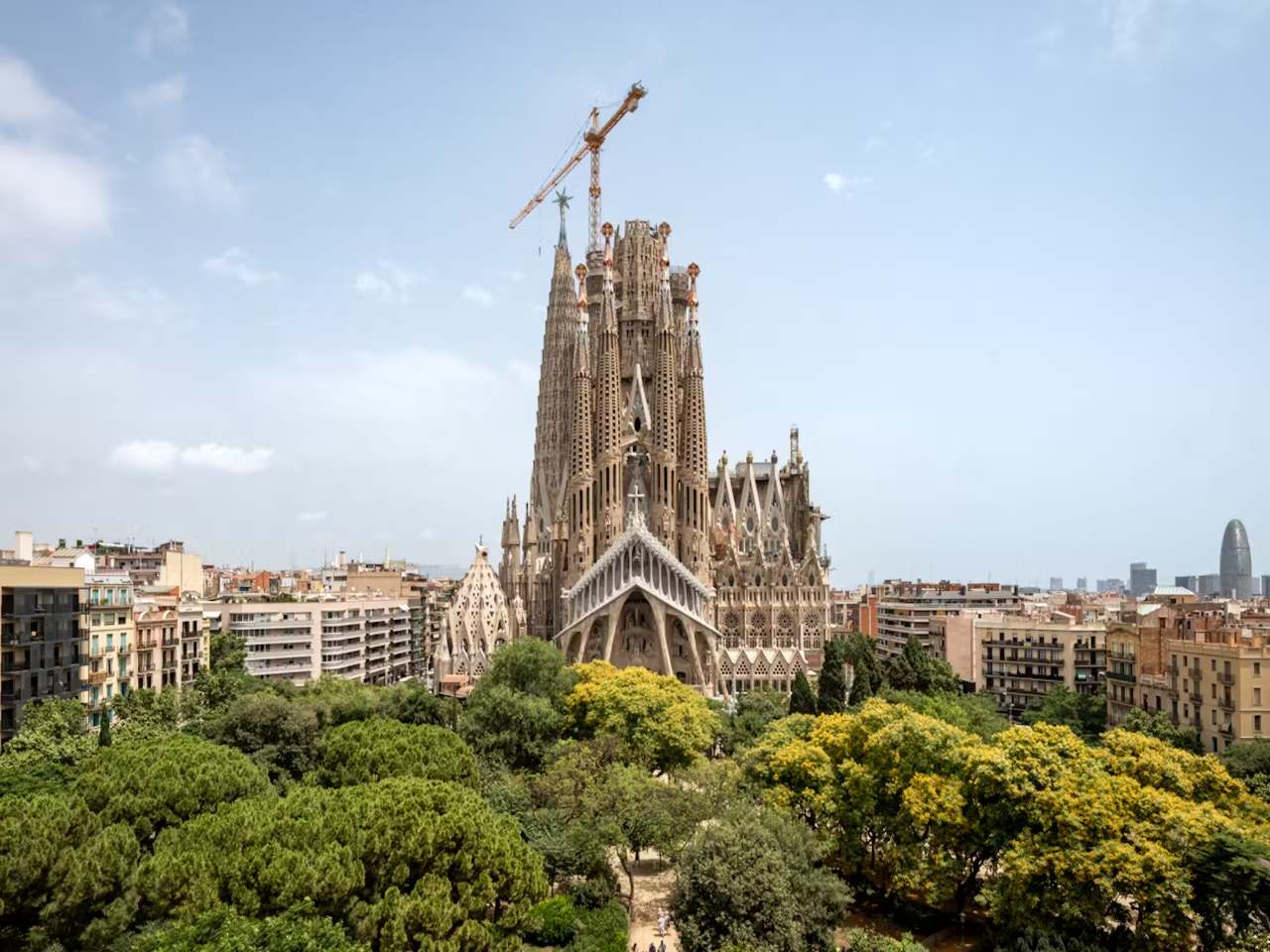
The Sagrada Familia is Antoni Gaudí's basilica in the Eixample district of Barcelona, still under construction more than 140 years after the first stone was laid in 1882. You go in with a nominative ticket for a set date and time slot, showing photo ID at the entrance, and the fast-track ticket starts from €33.80, with the towers as an option.
In this guide we at Where to go in Europe cover the opening hours until February 2027, which ticket to pick between basic entry, towers and guided tour, how to get there by metro, the dress code at the security check and what to see inside, from the forest of columns to the stained glass.



4.7
4.4
Availability checked on 28 November at 08:10. The price is the lowest of the next 3 months.
4.5
Got a question before or after booking? Write to us from the Contact page: we answer everyone.
Your booking arrives by email as soon as you pay and you show it from your smartphone. Nothing to print.
Tiqets and Viator have plenty of options: in the box you only find the ones we would book ourselves.
We check prices and dates for you: the time of the last check is written under the list.
Cancellation and date changes are under each option, with a tick if you can and a cross if you can't. No surprises later.
Where it says «skip the line» you go in through the entrance for visitors who booked: no queue at the ticket office.
From November to February the Sagrada Familia opens at 9:00 from Monday to Saturday and at 10:30 on Sunday, and closes at 18:00 every day. In March and October weekdays run until 19:00, from April to September until 20:00, while Saturday always closes at 18:00.
| PERIOD | Monday to Friday | Saturday | Sunday |
|---|---|---|---|
| November to February | 9:00-18:00 | 9:00-18:00 | 10:30-18:00 |
| March and October | 9:00-19:00 | 9:00-18:00 | 10:30-19:00 |
| April to September | 9:00-20:00 | 9:00-18:00 | 10:30-20:00 |
There is no fixed closing day, but a few dates have their own hours:
| DAY | What happens |
|---|---|
| 25 and 26 December | Open 9:00-14:00 |
| 1 and 6 January | Open 9:00-14:00 |
| Every day, 9:00-10:00 | Quiet hour: earphones required for audio guides and phones, visitors asked to stay silent |
| Special events | Hours and open days can change when there is an event inside the Basilica |
The ticket is nominative and tied to a time slot. Your name goes on it when you buy, it can’t be changed later, and at the entrance you show official photo ID together with the ticket on your phone or printed.
If you arrive after your slot, you don’t get in, and you can’t use the ticket on another day or at another time. Tickets go on sale roughly two months before the visit.
How long it takes: about 1 hour for the Basilica with the audio guide, 1h 30 if you add a tower. Inside the Basilica and the museum there is no time limit, so nobody rushes you out.
When to go: if you want the nave at its quietest, take a slot between 9:00 and 10:00. Since 2 February 2026 that is the daily quiet hour, kept for prayer: the visit goes on as normal, but without earphones no audio is allowed.
Mass is free, with limited seats. The international mass is held every Sunday and holy day of obligation at 9:00, with entry from the Nativity façade on Carrer de la Marina, and there is also an international evening mass every Saturday at 20:00.
The Sagrada Familia has its own metro stop: Sagrada Família, on lines L2 and L5. Individual visitors go in through the general entrance on the Nativity façade, on Carrer de la Marina.
 Metro L2 and L5: Sagrada Família stop, an accessible station
 Bus: 19, 33, 34, D50, H10 and B24
 Entrance: general entrance on the Nativity façade, Carrer de la Marina. Groups use the group entrance on the same street, disabled visitors entrance BGuided tour meeting point: the Julià Travel office at Carrer de Sardenya 311, where you check in at the counter 15 minutes before the tour
Book a slot that leaves you some margin. Every visitor goes through a check of bags and personal items with metal detectors, and a late arrival means losing the ticket.
Eat before or after the visit, not during it. Food and drinks from outside are not allowed in, eating is not allowed anywhere on the grounds, and you can only drink outside the building.
Leave suitcases at the hotel: there are no lockers for luggage, and the Basilica recommends not bringing rucksacks, to speed up the security check.
These five are the best-rated places within a 15-minute walk, among those with at least 300 Google reviews.
Ratings and number of reviews from Google Maps, updated on 10 November 2026.
The fast-track ticket in the tickets box includes an audio guide in English that you download to your phone. Bring your own earphones and a fully charged phone: between 9:00 and 10:00 earphones are compulsory.
The Basilica’s audio guide comes in two lengths: a standard version of 45 minutes and an express one of 25. It is available in 19 languages, plus sign guides in Catalan, Spanish and International Sign, and it is not designed for children under 10.
The same audio guide includes “What you don’t see”, an augmented reality experience that shows the hidden parts of the Basilica. Download everything before you arrive, not in the queue.
If you prefer a person to an app, the second option in the box is a 1h 30 guided tour in English with a local guide, skip-the-line entry included. It doesn’t include the towers, and groups are up to 30 people. When you book, pick the option “Guided Tour in English”.

Up to 9 people you are individual visitors: friends or family buy individual tickets, one per person, each with their own name.
From 10 people up you are a group, and groups can’t enter with individual tickets. A group must book in advance directly with the Basilica, is always charged for at least 10 people and must be accompanied by an official guide accredited by the Government of Catalonia.
Group visits go up to 30 people, with a special entrance and route and audio equipment to follow the guide. Groups use the group entrance on Carrer de la Marina.
Fewer than 10 of you and you want a guide anyway? Each of you books a place on the guided tour in the tickets box, which takes up to 30 people.
Visitors under 16 must be accompanied by an adult, in the Basilica and in the towers. Bags are checked at the entrance and food and drinks are not allowed in, so keep snacks for after the visit.
The towers have their own age rule: children under 6 can’t go up, and from 6 to 16 they go up only with an adult. You go up by lift and come down on foot, with bags and rucksacks left in the lockers.
The whole Basilica is accessible except the towers. The tower visit is not adapted for people with reduced mobility, so the basic ticket is the one to choose.
Disabled visitors and people with reduced mobility go in through entrance B on Carrer de la Marina, with priority access; disabled visitors must show official proof of the disability.
Wheelchairs are available at entrance B, subject to availability. The Sagrada Família metro station is accessible, with a guide path to the TMB customer point at the Provença and Marina entrance.
For deaf visitors the audio guide has sign guides in Catalan, Spanish and International Sign. If you have a pacemaker or another implant, you can go through the metal detectors safely, but tell the security staff first. The same applies if you are pregnant.
Only guide dogs are allowed, with the disabled visitors who need them. Any other dog stays outside, so plan for someone to look after it for the hour or more of the visit.
It is a Catholic church, and the dress code is checked. Trousers and skirts must reach at least mid-thigh, and you can’t go in with see-through clothing, swimwear, bare feet or costumes for celebrations.
Bare shoulders are not allowed in the Chapel of the Holy Sacrament: a light scarf in your bag solves it. Hats come off in the nave and the museum, except for religious, health or belief-related reasons.
At the entrance every bag goes through the check, and dangerous items, narcotics, food and drinks are not allowed in. There is no luggage storage: the only lockers are for bags during the tower visit.
Inside, keep your voice down and don’t run. Smoking and eating are not allowed anywhere on the grounds, and you can only drink outside the building.
Tripods are not allowed without accreditation from the press office, and photos or videos for commercial use need written authorisation. The visit route can change for safety, restoration, maintenance, bad weather or special events.
The fast-track ticket in our tickets box starts from €33.80: tower access is an option of the same ticket. The box also has a 1h 30 guided tour in English with a local guide.
Yes. Tickets are sold online, for a set date and time slot, and go on sale roughly two months ahead. There are purchase QR codes around the Basilica, but they only sell what is left at that moment, so for a set day book from the tickets box.
From November to February it opens at 9:00 from Monday to Saturday and at 10:30 on Sunday, and closes at 18:00. On 25 and 26 December and on 1 and 6 January it is open from 9:00 to 14:00. In March and October it closes at 19:00 on weekdays, from April to September at 20:00.
About 1 hour for the Basilica, 1h 30 if you add a tower. The guided tour in our box lasts 1h 30. Inside the Basilica and the museum there is no time limit, so you can stay longer.
You don't get in: the ticket is only valid for the time slot you chose. Allow time for the bag check with metal detectors at the entrance.
Yes, it is a Catholic church. Trousers and skirts must reach at least mid-thigh, and no see-through clothing, swimwear or bare feet. No hats in the nave and the museum, and bare shoulders are not allowed in the Chapel of the Holy Sacrament.
Children under 6 can't go up the towers, and from 6 to 16 they must be with an adult. You go up by lift and walk down, and bags and rucksacks go into the lockers before you start.
Not yet. The tower of Jesus Christ, 172.5 metres, was completed in 2026 and blessed on 10 June, the centenary of Gaudí's death. The four bell towers of the Glory façade are still to be built, and the Basilica gives no completion date.
These are the parts to look for during your visit, from the two finished façades to the museum.
This is the façade of the general entrance, on Carrer de la Marina, and the first one to be built, overseen directly by Gaudí. It tells the birth of Jesus: look for the animals and plants, and for the two turtles the columns between the portals stand on.
The figures of the Nativity façade were moulded from real people and animals.

On Carrer de Sardenya to the west, it tells the death of Jesus with the sculptures of Josep Maria Subirachs, commissioned in 1986. Gaudí wanted it “harsh and cruel, as if made of bones”: the six slanted columns of the portal hold up eighteen more, shaped like bones.
Its four bell towers were completed in the 1970s.

The columns branch out like trees and hold up vaults 45 metres high in the central nave and 75 in the apse. Gaudí wanted it to look like a forest. On the floor at the centre of the crossing, look for the ceramic letters JMJ, Jesus, Mary and Joseph.
Each column is made of a different stone depending on the weight it carries; the four at the centre are red porphyry.

It is by Joan Vila-Grau, who started on it in 1999 following Gaudí’s guidelines: blue tones on the Nativity side, like the morning light, orange on the west side, like the evening light. The windows are darker at the bottom and more transparent towards the top.
The warm colours are on the west side of the Basilica, the blue ones on the Nativity side.

With the tower option you go up one tower of the Nativity façade, looking over the east of Barcelona, or one of the Passion façade, looking over the city centre. You go up by lift and walk down, and children under 6 can’t go. The tallest, the tower of Jesus Christ, reaches 172.5 metres.
The six central towers are dedicated to Jesus, Mary and the four Evangelists.

It is included in the basic ticket and explains how the building was designed: look for the polyfunicular model, the string model Gaudí used to design the church at Colònia Güell, and the room with a mapping on four models.


