

Upper Belvedere: entry ticket
4.6
- Entry to the Upper Belvedere and its permanent collection
- Temporary exhibition and Marble Hall included
- Free cancellation up to 24 hours before
Pick a city
 9 min read
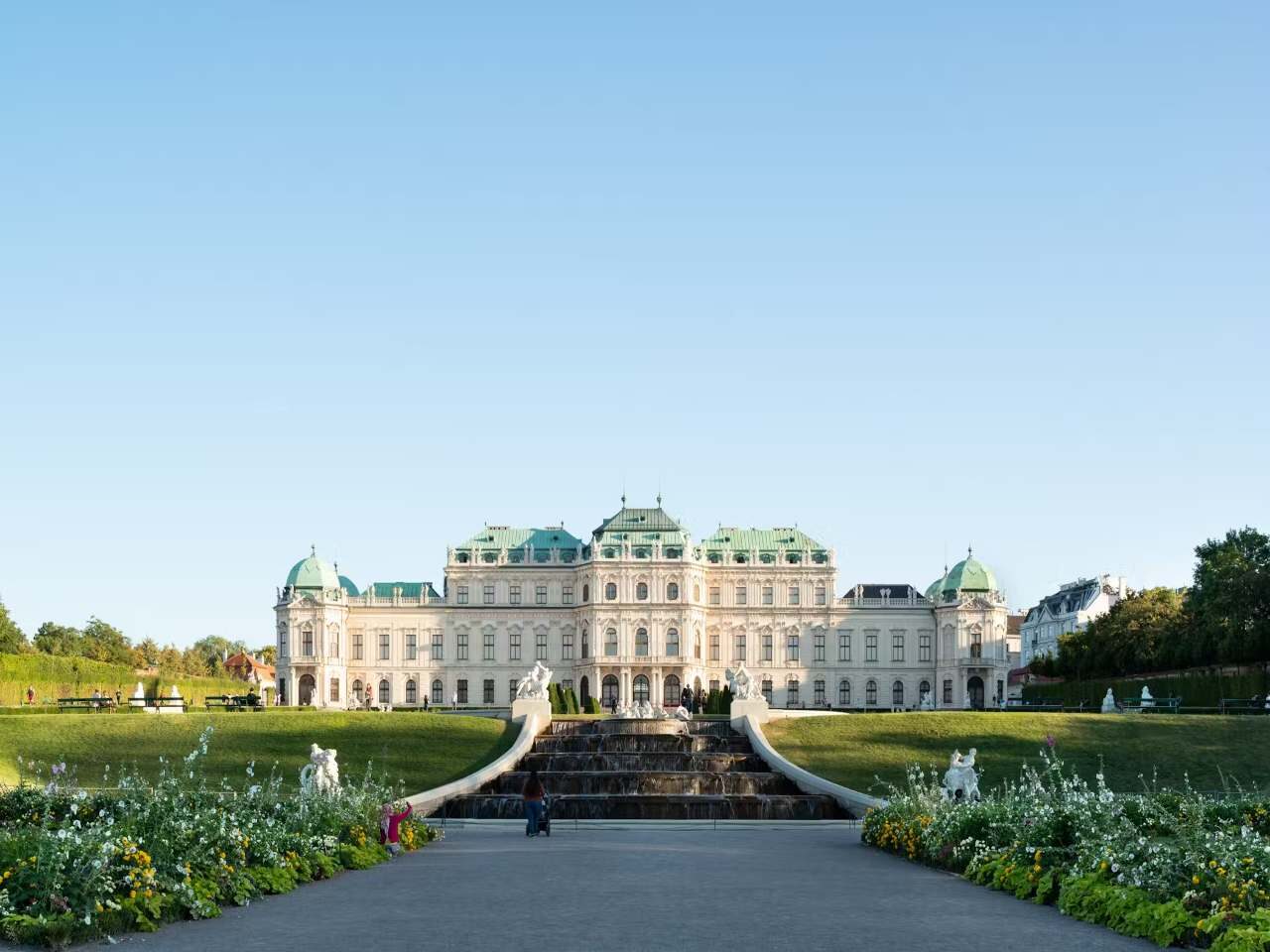
The Upper Belvedere is the Baroque palace at Prinz-Eugen-Straße 27 in Vienna that holds the Belvedere collection, with Gustav Klimt's The Kiss and masterpieces by Schiele, Funke, Messerschmidt and van Gogh. You enter with a ticket for a set time slot and can then stay as long as you like, and the entry ticket starts from €23.00.
In this guide we at Where to go in Europe cover the opening hours until February 2027, the quietest times of day, how to get there by tram D or the U1, the bag and photo rules, accessibility and on which level to find The Kiss and the other key works.



4.6
4.8
Availability checked on 28 November at 08:10. The price is the lowest of the next 3 months.
4.4
Got a question before or after booking? Write to us from the Contact page: we answer everyone.
Your booking arrives by email as soon as you pay and you show it from your smartphone. Nothing to print.
Tiqets and Viator have plenty of options: in the box you only find the ones we would book ourselves.
We check prices and dates for you: the time of the last check is written under the list.
Cancellation and date changes are under each option, with a tick if you can and a cross if you can't. No surprises later.
The Upper Belvedere is open Monday to Sunday from 9:00 to 18:00, with last admission at 17:30. The museum closes exactly on the hour and asks visitors to leave on time.
| PERIOD | Monday to Sunday | Last admission |
|---|---|---|
| November 2026 to February 2027 | 9:00-18:00 | 17:30 |
Every ticket has a time slot, which you choose when you buy it. The slot only sets when you walk in: once inside, the length of your visit is not limited.
The busiest hours are from 11:00 to 14:00, and weekends and holidays get crowded too. The museum suggests coming early in the morning or later in the afternoon, and even with a valid slot you may wait a little at the entrance at peak times.
The Lower Belvedere opens later, at 10:00, and closes at 18:00. If you want to see both, start at the Upper Belvedere at 9:00 and then walk down through the garden.
Tram D stops right at the palace, at Schloss Belvedere; trams 18 and O and the trains stop at Quartier Belvedere. The entrance is at Prinz-Eugen-Straße 27.
 Tram D: Schloss Belvedere stopTrams 18 and O: Quartier Belvedere stop
 Trains and S-Bahn: Quartier Belvedere station
 U1 underground: Südtiroler Platz / Hauptbahnhof, then about 15 minutes on foot
 Entrance: Prinz-Eugen-Straße 27, 1030 Vienna
By bike, there is bike parking in the palace gardens at the Prinz-Eugen-Straße and Landstraßer Gürtel entrances, and a city bike station close by. By car, the museum has a parking deal for up to 6 hours at the BIP garages at Palais Schwarzenberg and Schwarzenbergplatz, but it doesn’t apply if you pay with the parking app.
The parking area for disabled visitors is right next to the entrance, at Prinz-Eugen-Straße 27. There is also a charging station for electric cars nearby.
The Schlosscafé is inside the palace and keeps the museum’s hours, 9:00 to 18:00 every day. Its outdoor terrace looks over the Baroque garden towards the Lower Belvedere, for coffee and cake or a quick lunch.
You can’t carry or eat food and drinks in the exhibition rooms, so take your break at the café or in the garden. The garden is free and, from November to February, open from 7:00 to 17:30.
Outside, the Belvedere itself suggests a few places: Café Goldegg, a traditional Viennese coffeehouse a few minutes’ walk away, and Lokal im Hof for a late lunch. Between the Upper Belvedere and Belvedere 21, the Erste Campus has Japanese and Italian food, bowls and cafés, and around Vienna’s main station there is plenty of takeaway.
These five are the best-rated places within a 15-minute walk, among those with at least 300 Google reviews.
Ratings and number of reviews from Google Maps, updated on 12 November 2026.
At the Upper Belvedere ticket counter you can rent an audio guide in 12 languages, English included, while devices last. Bring your own headphones with a standard 3.5 mm jack; disposable ones are sold only if available.
The museum also has a Smartify audio tour of the collection on your own phone: 32 stops, about 60 minutes, in English and ten other languages, available until 31 December 2026. If you’d rather follow a guide, the second option in the tickets box is a 2-hour guided tour in English of the palace and its gardens.
Groups must reserve in advance at all three Belvedere venues, and the reservation is free. Until further notice a group means at least 10 and at most 20 people, the guide included.
There is no group discount at the moment. If you just want a guide, the tickets box has a 2-hour guided tour in English that you book per person.
Children and young people under 19 get in free, but they still need a time-slot ticket. Parents and guardians are responsible for how children behave, and the frames are often closer than they look, so agree on a little distance before you go in.
The Belvedere also runs family workshops: the admission is included in the event ticket, and at least one adult has to come for every three children. The kids and families programme is published in German.
The main entrance of the Upper Belvedere is at ground level, through two heavy single-leaf doors 102 cm wide. All areas inside are reached by lift, and there are accessible toilets and seating in the galleries.
The accessible ticket counter is the group ticket counter: the regular counters in the ticket shop are not barrier-free. Wheelchairs are available free of charge at all cloakrooms, folding stools are available there too, and the shop and the café are accessible for wheelchair users.
Disabled visitors with a Disability Card (Behindertenpass) get a reduced ticket, and a companion gets in free when the card notes the need. The path through the garden down to the Lower Belvedere is not barrier-free.
For blind and visually impaired visitors there are tactile stations with touchable replicas of works by Klimt, Schiele, Master I.P. and Messerschmidt, plus an audio description guide. Deaf visitors can use a video guide in Austrian and International Sign Language.
No animals are allowed in the museum, except guide dogs. Service dogs must be certified in Austria or the EU and listed in the disability card, and the palace garden doesn’t allow dogs or other pets either.
You can’t go in with coats, umbrellas, backpacks, travel bags or handbags: leave them at the cloakroom or in the free lockers. Luggage and large items can’t be stored in any case, and bags are occasionally checked.
Photos and videos are allowed for private use, without flash, tripods or selfie sticks, except where a room, an exhibition or a work is marked with a ban. Don’t touch the works, keep phone calls and loud voices out of the rooms, and remember that smoking is not allowed anywhere in the museum.
The entry ticket in our tickets box starts from €23.00 and covers the permanent collection, the temporary exhibition and the Marble Hall. Children and young people under 19 get in free.
Monday to Sunday, 9:00 to 18:00. The last admission is at 17:30, and the museum closes exactly on the hour, so plan to be out by 18:00.
Yes, the Upper Belvedere only lets you in with a time-slot ticket. The slot fixes when you enter, not how long you stay. With the Vienna PASS, in our box, you don't book a slot: you go straight to the entrance with an ID.
On level 1, in the Vienna 1900 section of the collection display Picture this!. The same level holds the Baroque rooms with Messerschmidt's Character Heads and the Neoclassicism and Biedermeier rooms.
Yes, for private use, without flash, tripods or selfie sticks. Rooms, exhibitions or single works marked with a photo ban are the exception.
Backpacks, handbags, umbrellas and coats have to go to the cloakroom or the free lockers. Luggage can't be stored at all: the museum suggests the lockers at Vienna's main station for large bags.
No, the entry ticket in our box covers the Upper Belvedere only. The Lower Belvedere, at Rennweg 6 at the other end of the garden, is a separate museum with its own ticket.
The museum says one to two hours per location is enough for a first look. The guided tour in our box lasts 2 hours, the palace gardens included.
The collection display Picture this! runs in chronological order over three levels, from the Middle Ages on level 0 to the 1970s on level 2, with self-portraits marking each section.
Klimt’s The Kiss is the centre of the Vienna 1900 section. The couple stands in a flowering meadow against a dark background speckled with gold, wrapped in robes that merge into one ornamental shape. It is a key work of the period in which Klimt worked with real gold leaf, and the museum notes that the effect of his golden paintings changes with the light.
Klimt is not the only big name of Vienna 1900 here: the museum’s audio tour on that period also covers Egon Schiele, Helene Funke and Oskar Kokoschka. Works featured in Picture this! include Schiele’s Squatting Couple (The Family), Funke’s Dreams, Cranach’s Stigmatization of St Francis, David’s Napoleon at the Great St Bernard Pass, Waldmüller’s Self-Portrait as a Young Man and Maria Lassnig’s Double Self-Portrait with Camera.
The Baroque rooms on level 1 hold Franz Xaver Messerschmidt’s Character Heads, a series of grimacing busts that still puzzles viewers. Around them hang large commissions for the nobility and the Church, together with landscapes and still lifes.
The rooms from 1800 to 1865 turn to everyday life and to nature, with the mountains of the Salzkammergut and the Berchtesgaden area among the favourite subjects. Artists looked less to past events and more to the here and now, with its social contrasts in town and country.
Level 2 covers Emerging Modernism and the avant-gardes from the 1920s to the 1970s, with Viennese Actionism and a generation of feminist artists who took apart patriarchal structures and gender roles.
The tour starts on level 0, with paintings and sculptures from the late 12th century to around 1600. These rooms trace the shift from Romanesque to Gothic art and on to the early Renaissance.
The Marble Hall is included in the entry ticket, with Carlo Carlone’s ceiling fresco, Gaetano Fanti’s painted architecture and a view over Vienna. In the Baroque Carlone Hall, until 29 March 2027, Asta Gröting’s video Things shows objects flying in slow motion into a deep blue sky.
The garden runs over three large terraces between the Upper and the Lower Belvedere, with symmetrical flower beds, water basins, steps and trimmed hedges. On the south side of the palace, the reflecting pool doubles the façade, so it’s worth walking round the building.
The garden is free: from November to February it is open from 7:00 to 17:30.

